The Journal · Rituals
Daily Rituals to Keep You Young
The body is energy, and energy wants to move
Watch a river and you learn everything you need to know about staying young. Where water moves, it stays clear and alive. Where it stops, it grows heavy, cloudy and still. Bugs and mold appear, and the water become sick.
The body is no different. Every ancient healing tradition, from Traditional Chinese Medicine's qi to Ayurveda's prana, describes us first as energy and only second as flesh and bone. Breath, blood, lymph, thought and feeling are all currents, and health is simply what happens when those currents flow.
We rarely age because of time alone. We age when things stop moving: when we hold our breath, hold our tongue, hold onto a hurt for years. This article is about the small, daily rituals that keep the river running, so the body stays soft, warm and free.
Where energy gets stuck
In yogic tradition, energy travels through seven centres called chakras, Sanskrit for "wheels". Each one spins along the spine, sits beside a cluster of organs, and holds a particular kind of emotional experience. When a wheel slows or stalls, we feel it twice: once as a mood, and once as a sensation in the body.
| Chakra | Where it sits | What it governs in the body | When it's blocked, you may feel |
|---|---|---|---|
| Root (Muladhara) | Base of the spine | Legs, feet, bones, colon, adrenals | Anxious, unsafe, ungrounded, tired |
| Sacral (Svadhisthana) | Lower belly and groin | Reproductive organs, kidneys, bladder, hips | Indecisive, uninspired, stuck, unable to go with the flow |
| Solar plexus (Manipura) | Upper belly | Stomach, liver, pancreas, digestion | Powerless, self-doubting, bloated, tense |
| Heart (Anahata) | Centre of the chest | Heart, lungs, breasts, arms, hands | Heavy, guarded, lonely, grieving |
| Throat (Vishuddha) | Throat and neck | Thyroid, jaw, mouth, voice | Unheard, holding back, a lump in the throat |
| Third eye (Ajna) | Between the brows | Eyes, sinuses, brain | Foggy, confused, disconnected from intuition |
| Crown (Sahasrara) | Top of the head | Nervous system, the whole body | Isolated, uninspired, without purpose |
You already know this map, even if you have never named it. Heartache sits in the chest like a stone; we call it a heavy heart because that is exactly how it feels. Unable to make a decision, we feel it low in the belly and hips, a kind of standstill where our creative, flowing energy should be.
And the words we never say? They gather in the throat. The tight jaw, the swallowed reply, the voice that cracks when we finally speak our truth. Every unsaid thing is energy that was meant to leave the body and didn't.
The chakras are a traditional map rather than a medical one, but they offer something modern life rarely does: permission to treat emotion as something physical, something we can move with our hands, our breath and our feet.
Why stillness ages us
Traditional Chinese Medicine has a saying: tong ze bu tong, "where there is free flow, there is no pain; where there is pain, there is no free flow." Stagnant qi, in this view, is where illness begins: first as tension, then as heat and swelling, and eventually as disease.
Modern science has arrived somewhere surprisingly close. Researchers now use the word inflammaging to describe the low, simmering inflammation that builds in the body over time. It is linked to many of the conditions we associate with growing older, from stiff joints to heart disease, and long hours of sitting still are one of the habits that feed it.
The bridge between the two worlds is the lymphatic system. This quiet network of vessels and hundreds of nodes carries away waste, excess fluid and spent cells, and moves our immune defences around the body. Unlike blood, lymph has no heart to pump it. It moves only when we do: when muscles contract, when we breathe deeply, when we stretch, bounce and twist.
So a still body is, quite literally, a body that isn't clearing itself. Puffiness, heaviness, sluggish mornings and that foggy, stuck feeling are often the first signs. The good news is that the remedy is simple, free and takes minutes a day.
Five daily rituals to keep energy moving
None of these require a studio, a subscription or more than a few minutes. What they share is simple: each one creates movement, warmth and release, waking the body from the outside in.
1. Dry brushing: wake the skin, guide the lymph
Your skin is your largest organ, and just beneath it runs much of your lymphatic network. Dry brushing stimulates circulation, lifts away dead skin and leaves you warm and tingling, as if the body has been switched on.
- Use a natural-bristle brush on dry skin, before your morning shower.
- Start at the soles of your feet and sweep upwards in long, light strokes, always towards the heart.
- Move up the legs, over the belly in slow clockwise circles, then from the hands up the arms.
- Finish by sweeping gently down the neck and across the chest towards the collarbones, where lymph drains back into the blood.
Keep the pressure soft, like a cat's tongue rather than a scrub, and skip any broken, irritated or sensitive skin.
Moves: the whole body, especially the root and sacral centres as you brush up from the feet.
2. Shaking: let the body let go
Watch an animal after a fright and you will see it shake from nose to tail, then calmly walk away. We are built to do the same, but we have learned to hold it in. Shaking is one of the oldest practices in qigong, and one of the quickest ways to release tension stored in the muscles.
- Stand with feet hip-width apart, knees soft.
- Begin to bounce gently through the heels, letting the movement travel up through the knees, hips, shoulders and hands.
- Let the jaw loosen and the breath fall out of the mouth. Sigh, hum, make noise if it comes.
- Shake for two to five minutes, then stand completely still and feel the hum of energy through the body.
Moves: root and sacral energy first, then everything held above it.
3. Swinging and jumping: open the chest, pump the lymph
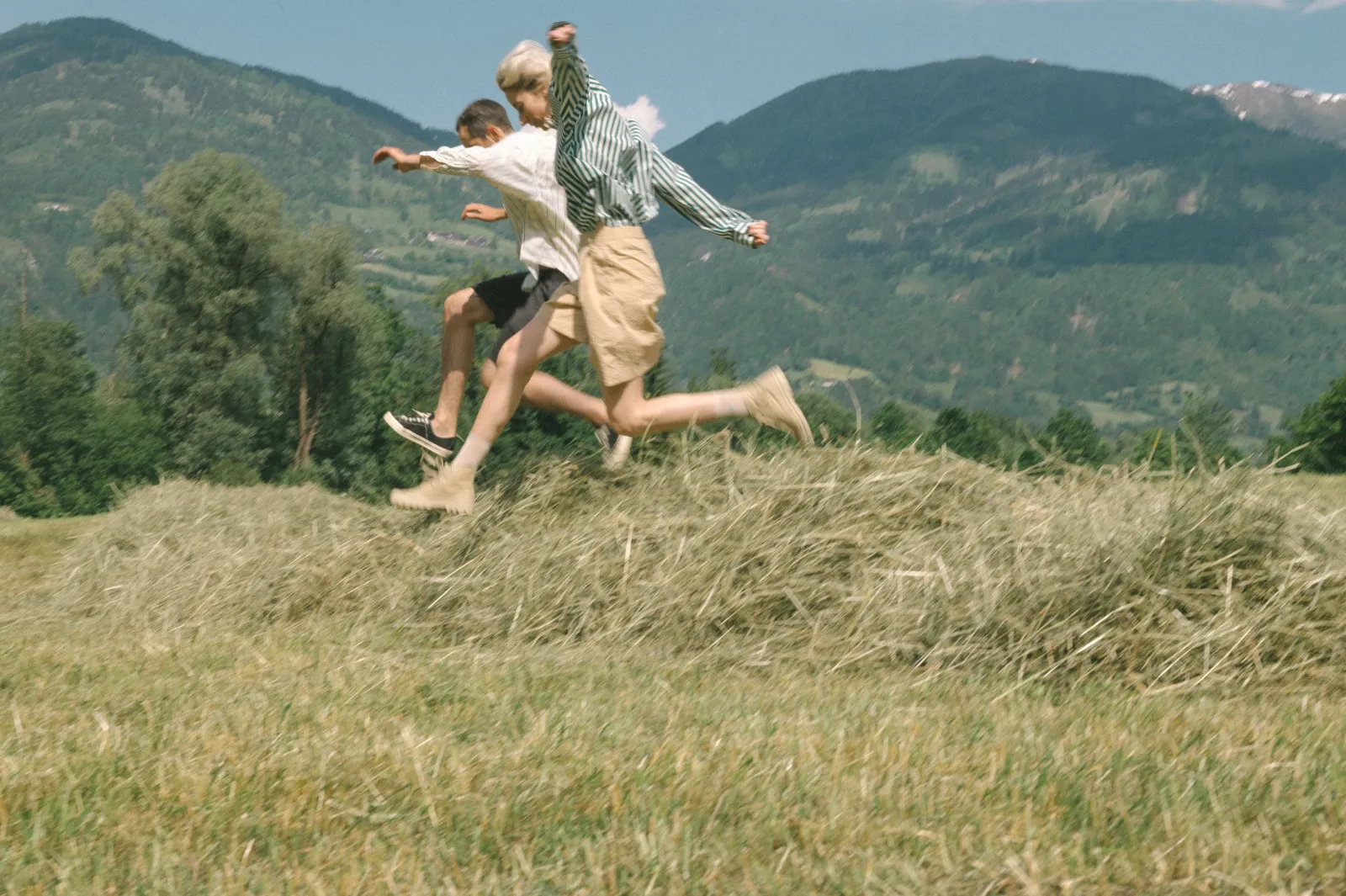
Rhythmic movement is the lymph's favourite pump. Every bounce and twist squeezes the vessels and sends fluid on its way, while swinging the arms opens the ribs and the space around the heart.
- Arm swings: with feet planted, twist gently from the waist and let your arms swing loosely around you, hands softly tapping the body. Thirty to sixty swings.
- Small jumps: bounce lightly on the balls of your feet, or on a mini trampoline, for one to two minutes. Heels barely need to leave the ground.
- Open the heart: finish with a few wide arm circles, drawing the chest open on each inhale.
If your knees or pelvic floor need care, keep the bounce in your heels and let the feet stay on the floor.
Moves: the solar plexus through the twist, the heart through the open chest.
4. Tongue scraping: clear the gateway
In Ayurveda, the coating that gathers on the tongue overnight is called ama: residue the body is trying to clear. Scraping it away each morning freshens the breath, sharpens taste and, symbolically, clears the space through which we speak.
- On waking, before drinking anything, take a copper or stainless steel scraper.
- Place it as far back on the tongue as is comfortable and draw it forward in one smooth stroke.
- Rinse and repeat seven to ten times, then follow with a glass of warm water.
Pair it with a minute of humming, or speaking one true thing aloud, to give the throat its own release.
Moves: the throat, the home of your voice and your truth.
5. Ear rubbing: warm the root of vitality
In Traditional Chinese Medicine, the ears are a map of the entire body, holding points that connect to every organ. They are also said to open into the kidneys, which store jing: the deep essence that governs how gracefully we age.
- Rub your palms together until they are warm.
- Hold the ears and rub them briskly, front and back, until they glow.
- Massage the outer rim from top to bottom between finger and thumb.
- Finish by gently tugging the lobes downwards ten times.
This is one of the fastest ways to heat up the body and clear a foggy head, which makes it perfect for a mid-afternoon slump.
Moves: the third eye and crown, and in TCM, the kidneys' store of vitality.
Your ten-minute morning ritual
Woven together, these practices take ten minutes and move energy through every centre, from the feet to the crown. Do them in this order, before coffee and before your phone.
| Time | Ritual | What it moves |
|---|---|---|
| 1 min | Tongue scraping, then a glass of warm water | Throat: clearing the night away |
| 3 min | Dry brushing, feet to heart | Lymph and skin: waking the whole body |
| 3 min | Shaking, ending in stillness | Root and sacral: releasing what was held |
| 2 min | Arm swings and small jumps | Solar plexus and heart: opening and pumping |
| 1 min | Ear rubbing | Third eye and crown: warmth and clarity |
Then step into a warm shower, finishing with thirty seconds of cool water if you can. You will leave the bathroom warm, awake and lighter than you entered it.
Soft and free
At Matamala, we believe in killing the bad: gently letting go of what no longer serves us, without guilt, so balance can return. Stagnant energy is one of those things. It is the old hurt in the chest, the decision we keep postponing, the sentence we never said.
You don't need to fix it all at once. You only need to keep it moving. A few minutes each morning to brush, shake, swing, scrape and rub is a small promise to yourself that nothing will settle in long enough to harden.
Youth was never really about time. It is softness, warmth and flow, and it is something you can practise every single day.